GSM-R is an international wireless communications standard for railway communication and applications.
The GSM-R specifications and a set of activities, e.g. coordination at a European level of Transit Routing Agreements, are dealt with within the following UIC Working Groups:
The GSM-R OFG ensures monitoring of GSM-R usage (implementation reports), maintenance and development of GSM-R specifications (EIRENE and MORANE), which are included in the CCS TSI.
The GSM-R NMG is responsible for defining, developing and monitoring the technical processes for GSM-R interconnection between European countries.
The GSM-R ENIR manages the hubs (located in Germany and Switzerland), implementing the interconnection of European GSM-R networks.

Through its working groups, the ERTMS/GSM-R project brings together existing and future implementers of GSM-R, assisting the former in realising their objectives and keeping the latter - and the railway industry in general - informed of developments. Close cooperation is maintained with ETSI through the ETSI Technical Committee Rail Telecommunications and with the GSM-R Industry.
This section provides information on the system and its implementation, including the latest versions of the EIRENE specifications and the full range of specifications.
During the course of their work, the UIC radio frequency group concluded that efforts would need to be undertaken to negotiate with the European Frequency Committee (CEPT) for the allocation of a specific frequency band adjacent to the E-GSM band for railway use. This frequency band was intended to cover the current railway needs as well as the future railway needs. This request was supported by a pre-study on the usability of either GSM or TETRA systems for the future railway mobile communications. Some studies were undertaken to assess the possible frequency needs (Studies to define a traffic model for three representative areas, London, Paris and Munich, were carried out). In parallel, the advantages and disadvantages of the two potential systems (GSM or TETRA) were discussed.
Finally, a decision was taken to adopt GSM, which was, at that time, the only system in commercial operation with products available. This was a very important consideration as one of the main objectives was to use a system already proven with off-the-shelf products available with minimum modifications.
However, even at that time it was clear, that GSM could not fulfil all the requirements necessary for an efficient railway service. Therefore, it was necessary to identify and add to the standard GSM the Advanced Speech Call Items (ASCI) features.
The request for frequencies resulted in a recommendation from CEPT, to add 4 MHz to the overall GSM-band and to allocate it for railway use only.
This recommendation was later enhanced into a decision, which required the national frequency authorities to free this frequency band, which was already used (mainly by military services), by 2005 at the latest.
Following the decision to adopt GSM, the UIC launched a project in 1992, together with the EC and the railways, called EIRENE (European Integrated Radio Enhanced NEtwork). The aim of this project was, to specify the requirements for mobile networks which would both fulfil the needs of railways and ensure interoperability across borders. That involved the description of mandatory requirements for operational communication services, in and between networks of neighbouring railways, with the goal to allow, in the future, uninterrupted train-services, when crossing borders.
A project Team was established within this project. The group was tasked with preparing a set of requirements that would primarily describe the mandatory features necessary for interoperability. Additionally, a description of some optional features was envisaged to accommodate national requirements.
This document also sets out to define the requirements related to railway operation and the specification of the additional Group and Broadcast Calls features. A first draft of these EIRENE specifications was finalised by 1995.
As these features had to be incorporated within the GSM standards, it was necessary to work together with specialised ETSI working groups.
To develop the detailed specifications and validate that the EIRENE Functional Specifications could be translated into technical implementations, a European Call for Projects was launched in 1995. In response, a consortium of railways, GSM suppliers, and laboratories joined forces and was successfully awarded the project in 1996. This project, named MORANE (MObile Radio for RAilway Networks in Europe), was established with the support of a Steering Group composed of railways from France, Italy, and Germany, and was coordinated from Paris. Three pilot lines were planned and implemented:
Under the MORANE project, prototypes were developed by manufacturers, and three networks were established, with the corresponding fixed and mobile terminal equipment provided. The three systems were aimed at testing different aspects of operation, respectively Railway station environment, complex radio coverage topology with tunnels and bends, high speed lines able to handle 300km/h). It was possible to prove, during the lifetime of this project, that all the mandatory functions could be successfully implemented and tested.
The two Projects EIRENE and MORANE were finally concluded at the end of 2000 with the delivery of the FRS and SRS versions 4 and 12, respectively, the delivery of the MORANE FFFIS, FIS and FFFS documents and a final report incorporating the result of the measurement campaigns from all three trial sites.
In 1997, the UIC prepared a Memorandum of Understanding (MoU), committing the railways that signed this MoU to no longer investing in analogue radio systems, and only investing in the implementation of GSM-R. It also included the major statements, that early implementers would help the other railways starting an implementation, through the exchange of knowledge and experience.
This MoU was signed at that time by 32 railways all over Europe. The number of signatories has later increased to 37, including railways outside of Europe.
In addition to the declaration of willingness set out in the MoU, the UIC also instigated an Agreement of Implementation (AoI), where the signing railways committed themselves to start their implementation of the national GSM-R system in 2003 at the latest. This AoI was signed by 17 railways.

To complement the work carried out in EIRENE and MORANE the UIC started a new project, called ERTMS/GSM-R.
The new ERTMS/GSM-R project combined experiences from the trial-sites and knowledge from implementing railways within three permanent working groups:
ERIG forms the assembly of railways having signed the MoU and the AoI.
The main goal of this group is to exchange information about ongoing implementations based on results already achieved and discussion about gaps in the specifications or implementation reports related to national or international functions. Information is also provided on the work of the different permanent and ad hoc groups, and the presentation of actual change requests along with their status. This group is mainly a dissemination platform.
Functional Group (FG)
The main task of this expert group was to maintain the FRS and to check incoming Implementation Reports concerning the impact to functional requirements. The FG was also responsible for creating the Change Requests, based on Implementation Reports. The FG worked with OG and the GSM-R Industry Group (IG) to find the right solutions and requirements. The FG takes towards specification evolution to ensure consistent railway operation.
Operators' Group (OG)
The main task of this expert group was to maintain the SRS, to define technical solutions for functional requirements, to liaise with ETSI, the Standardisation body for GSM related to railway requirements, to create the necessary Change Requests based on Implementation Reports, to liaise with the GSM-R Industry Group (IG) and to define technical improvement necessary for new SRS releases. The OG was also responsible for creating a new version of the SRS and upgrading the former MORANE documents.
In 2017, due to an increase of UIC's focus on developing FRMCS – the GSM-R successor - UIC decided to merge the Functional Group (FG) and Operators Group (OG) as one common working group with a new name, “Operators and Functional Group” and the new acronym “OFG”, starting its work in 2018.
The Operators and Functional Group objectives and tasks
In parallel to these railway-oriented working groups, the GSM-R suppliers have formed a separate group, called GSM-R Industry Group (IG), which works on two aspects :
In 2018, a new group named UNITEL was established as part of UNIFE. IG has migrated all of the activities into UNITEL to have a single group representing the railway communication industry.
UNITEL working structure:
To protect the specific railway features and to improve the development of the GSM standard, UIC is deeply involved in the standardisation work with the ETSI Technical Committee on Rail Telecommunications. This ETSI Technical Committee is in a position to improve the standards, ensuring full interoperability of the System.
The EIRENE Functional Requirements Specification (FRS) version 8.1.0 and System Requirements Specification (SRS) version 16.1.0 are released to address the complete GSM-R system requirements, containing in particular the requirements that are relevant to interoperability of the rail system within the European Community, according to the Directive (EU) 2016/797.
The documents incorporate the relevant requirements introducing Internet Protocol based new Core Network architecture, making the system able to use either Packet Switching or Circuit Switching as a bearer for ETCS, allowing the usage of terminals offering improved protection against interferences and inserting the findings of a Working Group managed by the European Agency for Railways, with the participation of the UIC, CER, EIM and UNITEL Technical Group. They include the ability to use additional frequencies in the 900 MHz band and other public GSM bands, and introduce other reviewed functionalities for the network and the terminals.
The EIRENE Specifications requirements, which are relevant for interoperability in Europe, are strictly the ones marked in this version with the category (MI), and these should be verified for certification purposes and authorisation for placing into service in Europe. There is no impact for Individual Constituents or Subsystems certification done according to the applicable requirements in EIRENE's previous versions.
They are referenced in the Annexe A of the CCS TSI as mandatory documents according to the ERA ERTMS/GSM-R CCM process, and considered as such as the GSM-R European baseline, approved by the RISC Committee in February 2023.
The EIRENE version numbering structure is as follows:
Following this, EIRENE 8.1.0 & 16.1.0 are aligned with ERA B1 r1.
The complete set of Mandatory for Interoperability (MI) and Mandatory for the System (M) must be complied with together to ensure a viable working GSM-R system.
Following that, this split into two categories does not apply to non-European implementations.
Please note that this EIRENE Functional System Requirements Specification version 8.1.0 replaces the former version 8.0.0, and the EIRENE System Requirements Specification version 16.1.0 replaces the former versions 16.0.0.
EIRENE – Functional Requirements Specification - version 8.1.0 EIRENE – System Requirements Specification - version 16.1.0 Radio Transmission FFFIS for EuroRadio - version 14.0.0 (MORANE A 11 T 6001) FIS for Location Dependent Addressing - version 3 (MORANE F12 T 6001) FIS for Presentation of Functional Numbers to Called and Calling Parties - version 4 (MORANE F12 T 6003) FIS for Confirmation of High Priority Calls - version 5.0 (MORANE F12 T 6002) FIS for Functional Addressing - version 5.1 (MORANE E12 T 6001) FFFS for Location Dependent Addressing - version 4 (MORANE F10 T 6001) FFFS for Presentation of Functional Numbers to Called and Calling Parties - version 4 (MORANE F10 T 6003) FFFS for Confirmation of High Priority Calls - version 5.0 (MORANE F10 T 6002) FFFIS for GSM-R SIM Cards - version 6.0.0 (MORANE P38 T 9001)
Quality of Service Test Specification for EIRENE QoS requirements - version 2.0.0 (O-2875) Test specifications for GSM-R MI related requirements: Part 1: Cab Radio (O-3001-1 version 2.0.0) Test specifications for GSM-R MI related requirements: Part 2: EDOR (O-3001-2 version 2.0.0) Test specifications for GSM-R MI related requirements: Part 3: SIM Cards (O-3001-3 version 2.0.0) Test specifications for GSM-R MI related requirements: Part 4: Network (O-3001-4 version 2.0.0) Test specifications for GSM-R MI related requirements: Part 5: Cross Reference Table (O-3001-5 version 1.0.0) FFFS for Voice and Data Services Functionality at borders between GSM-R networks - version 3.0.0 (O-8300) FFFS for Voice and Data Services Interconnection & Roaming between GSM-R networks - version 3.0.0 (O-8350)
The EIRENE System Requirements and Functional Requirements Specifications allow for some flexibility in the allowed procurement approaches and implementation options for an EIRENE-compliant integrated radio communications system.
In order to ensure interoperability between national GSM-R networks, it is necessary to provide some guidance on the development of national specifications. This procurement and implementation guide is intended to provide help with the interpretation of the EIRENE Specifications in order to:
1. Provide a framework for interoperability; 2. Ensure common interpretation of requirements in the context of how EIRENE compliant systems may be implemented; 3. Provide guidance in areas where there is flexibility in the implementation options.
The remainder of this section outlines the aspects that are covered by the Procurement and Implementation Guide in order to meet these requirements.
The realization of a GSM-R network is complex and requires much planning. It is not intended that every topic related to GSM-R implementation is covered here in this version of the document. Future versions of the document will build upon the information provided here by adding new sections, error corrections or more in depth explanations in order to form a more comprehensive handbook for GSM-R implementers.
Document scope
In order to provide practical assistance to the implementation of an EIRENE-compliant radio network, this guide:
- Provides an overview of GSM-R and gives a single point of reference for all of the relevant documentation; - Describes the various design options available and how these implementations can be made to result in an interoperable EIRENE-compliant system; - Provides guidance on the use of the EIRENE System Requirements Specification and Functional Requirements Specification and explains how this information may be used to develop a national strategy; - Provides guidance on issues, which have an effect on implementation and interoperability, but are not comprehensively covered in the EIRENE Specifications.
EIRENE specs
Test cases
Other
PDF · 4.4 MB
View 2009gsm-r_guide.pdf
PDF · 370 KB
View EIRENE Functional Requirements Specification - V7 (May 2006)
PDF · 1.8 MB
View EIRENE System Requirements Specification - V15.1 (June 2010)
PDF · 514 KB
View EIRENE Functional Requirements Specification - V7.1 (June 2010)
PDF · 904 KB
View EIRENE System Requirements Specification - V15 (May 2006)
PDF · 520 KB
View EIRENE Functional Requirements Specification Version 7.3.0 (March 2012)
PDF · 834 KB
View EIRENE Functional Requirements Specification Version 7.4.0 (April 2014)
PDF · 2.0 MB
View EIRENE System Requirements Specification Version 15.3.0 (March 2012)
PDF · 1.7 MB
View EIRENE System Requirements Specification Version 15.4.0 (March 2014)
PDF · 726 KB
View EIRENE - Functional Requirements Specification Version 8.0.0
PDF · 1.8 MB
View EIRENE - System Requirements Specification Version 16.0.0
PDF · 140 KB
View E 10 T 6001 4 1 FFFS For Functional Addressing
PDF · 153 KB
View FIS for Functional Addressing - version 5.1 (MORANE E12 T 6001)
PDF · 104 KB
View FFFS for Location Dependent Addressing - version 4 (MORANE F10 T 6001)
PDF · 122 KB
View FFFS for Confirmation of High Priority Calls - version 5.0 (MORANE F10 T 6002)
PDF · 180 KB
View FFFS for Presentation of Functional Numbers to Called and Calling Parties - version 4 (MORANE F10 T 6003)
PDF · 90 KB
View FIS for Location Dependent Addressing - version 3 (MORANE F12 T 6001)
PDF · 56 KB
View FIS for Confirmation of High Priority Calls - version 5.0 (MORANE F12 T 6002)
PDF · 102 KB
View FIS for Presentation of Functional Numbers to Called and Calling Parties - version 4 (MORANE F12 T 6003)
PDF · 291 KB
View O 8350 1 0
PDF · 1.1 MB
View P38T9001 FFFIS for GSM R SIM CARD v5 0
PDF · 646 KB
View gsmr2875 1 0
PDF · 481 KB
View gsmr8300 2 0
PDF · 622 KB
View Assessment report on GSM-R current and future radio environment (O-8736 version 2.0)
PDF · 105 KB
View FRS for enhanced Location Dependent Addressing (version 4.0)
PDF · 327 KB
View IRS for enhanced Location Dependent Addressing (version 5.0)
PDF · 92 KB
View eREC Parameters (O-3152 version 1.1)
PDF · 2.6 MB
View eREC Specification (O-3151 version 2.0.0)
PDF · 486 KB
View GSM-R RF filter requirements (O-8760 version 1.0)
PDF · 1.3 MB
View Radio Transmission FFFIS for EuroRadio (2015)
PDF · 1.1 MB
View O-3001 2.0.0 Test specifications for GSM-R MI related requirements (May 2016)
PDF · 553 KB
View O-8350 FFFS for Voice and Data Services Interconnection & Roaming between GSM-R networks version 2.0 (2016)
PDF · 1.5 MB
View O-8664 ETCS in PS-mode GPRS-EGPRS Guideline version 1.0.0ETCS in PS-mode GPRS-EGPRS Guideline (O-8664 version 1.0.0)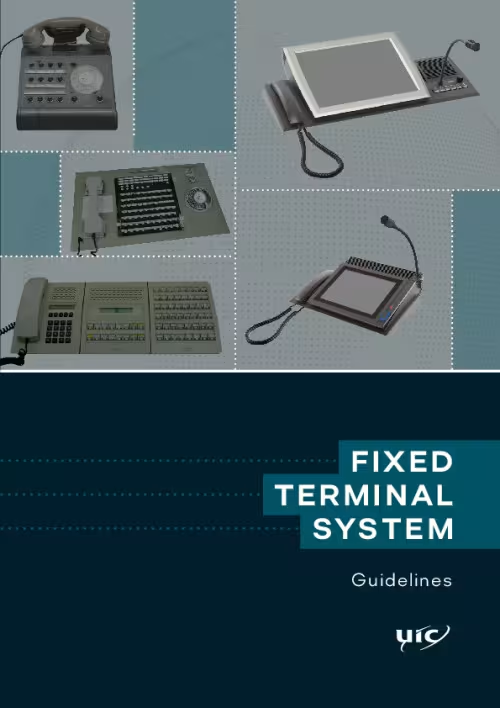
PDF · 1.6 MB
View Fixed Terminal System Guidelines (F-0445 version 1.0)
PDF · 1.3 MB
View O-3001-1 Test specifications for GSM-R MI related requirements; Part 1: Cab Radio Version 1.0.0 (July 2017)
PDF · 597 KB
View O-3001-2 Test specifications for GSM-R MI related requirements; Part 2: EDOR Version 1.0.0 (July 2017)
PDF · 893 KB
View O-3001-4 Test specifications for GSM-R MI related requirements FRS 8.0.0/SRS 16.0.0; Part 4: Network version 1.1.0
PDF · 210 KB
View O-3001-3 Test specifications for GSM-R MI related requirements; Part 3: SIM Cards version 1.0.0
PDF · 3.9 MB
View gsmr3114-1.0 Network Assessment Test Plan
ZIP · 1.5 MB
View Test PlansZIP · 1.0 MB
View Test Reports
PDF · 1.1 MB
View Quality of Service Test Specification for EIRENE QoS requirements - version 2.0.0 (O-2875)
PDF · 1.6 MB
View ETCS over GPRS/Edge capacity study in station environment (O-3300 version 1.0.0)
PDF · 191 KB
View Use cases for eREC based on Balise Reader Input (O-3261 version 1.0.0)
PDF · 639 KB
View O-3001-1 Test specifications for GSM-R related requirements: Part 1: Cab Radio version 1.1.0
PDF · 234 KB
View O-3001-2 Test specifications for GSM-R related requirements: Part 2: EDOR version 1.1.0
PDF · 102 KB
View O-3001-3 Test specifications for GSM-R related requirements: Part 3: SIM Cards version 1.1.0
PDF · 804 KB
View O-3001-4 Test specifications for GSM-R related requirements: Part 4: Network version 1.2.0
PDF · 303 KB
View FFFS for Voice and Data Services Functionality at borders between GSM-R networks - version 3.0.0 (O-8300)
PDF · 1.2 MB
View EIRENE – Functional Requirements Specification - version 8.1.0
PDF · 3.8 MB
View EIRENE – System Requirements Specification - version 16.1.0
PDF · 1.6 MB
View Radio Transmission FFFIS for EuroRadio - version 14.0.0 (MORANE A 11 T 6001)
PDF · 1.6 MB
View FFFS for Voice and Data Services Interconnection & Roaming between GSM-R networks - version 3.0.0 (O-8350)
PDF · 1.8 MB
View FFFIS for GSM-R SIM Cards - version 6.0.0 (MORANE P38 T 9001)
PDF · 1.6 MB
View Test specifications for GSM-R MI related requirements: Part 1: Cab Radio (O-3001-1 version 2.0.0)
PDF · 901 KB
View Test specifications for GSM-R MI related requirements: Part 2: EDOR (O-3001-2 version 2.0.0)
PDF · 707 KB
View Test specifications for GSM-R MI related requirements: Part 3: SIM Cards (O-3001-3 version 2.0.0)
PDF · 1.1 MB
View Test specifications for GSM-R MI related requirements: Part 4: Network (O-3001-4 version 2.0.0)
PDF · 1.5 MB
View Test specifications for GSM-R MI related requirements: Part 5: Cross Reference Table (O-3001-5 version 1.0.0)