

Valuing Nature for Resilient Railways
Background: What Ecosystem Services have to do with Railways?
Railway networks are deeply interconnected with the natural environments they pass through. Healthy ecosystems support safe and reliable operations by regulating water flows, stabilising soils and slopes, storing carbon, and contributing to climate resilience. At the same time, railway construction, operation, and maintenance can place significant pressure on ecosystems, with impacts that often extend beyond the immediate railway footprint.
Despite these interdependencies, ecosystem services are rarely considered systematically in railway planning and asset management. Environmental assessments tend to focus on regulatory compliance, while economic appraisals prioritise financial efficiency. This separation risks underestimating the contribution of nature to railway resilience and overlooking opportunities to enhance performance through integrated land management. ECOV4R addresses this gap by helping decision-makers improve resilience, demonstrate value, and support nature-positive outcomes across railway estates.
Objectives
- Develop a practical and scalable methodology for ecosystem service assessment in the rail sector
- Test the methodology through real-world pilot sites
- Provide actionable guidance and tools for railway managers and policymakers
Rail Sustainability - Ecosystem Services & the ECOV4R Project – Michael Image | 6/03/2026
Rail Sustainability - Ecosystem Services & the ECOV4R Project – Michael Image | 6/03/2026
The Framework
Overview
Railways both depend on and impact nature, yet ecosystem services are often underrepresented in infrastructure planning and asset management. The ECOV4R framework fills this gap by providing a structured, scalable methodology to assess, quantify, and, where possible, monetise the ecosystem services influenced by rail infrastructure and operations.
ECOV4R is designed for planners, asset managers, consultants, policymakers, and investors. It complements existing appraisal methods such as Environmental Impact Assessments (EIAs) and Cost-Benefit Analyses (CBAs), providing robust, evidence-based data on both positive contributions and negative impacts.
By embedding ecosystem services into decision-making, ECOV4R helps the rail sector:
- Recognise nature as a strategic asset for operational resilience.
- Quantify the societal and financial value of ecosystem services (e.g., flood regulation, carbon storage, biodiversity).
- Integrate ecosystem value into planning, project design, and sustainability reporting.
- Support climate adaptation, biodiversity objectives, and natural capital accounting.
- Promote nature-positive interventions that enhance rail infrastructure performance.
Rail Sustainability - The ECOV4R Framework – Natalya Kharadi | 6/03/2026
Methodology
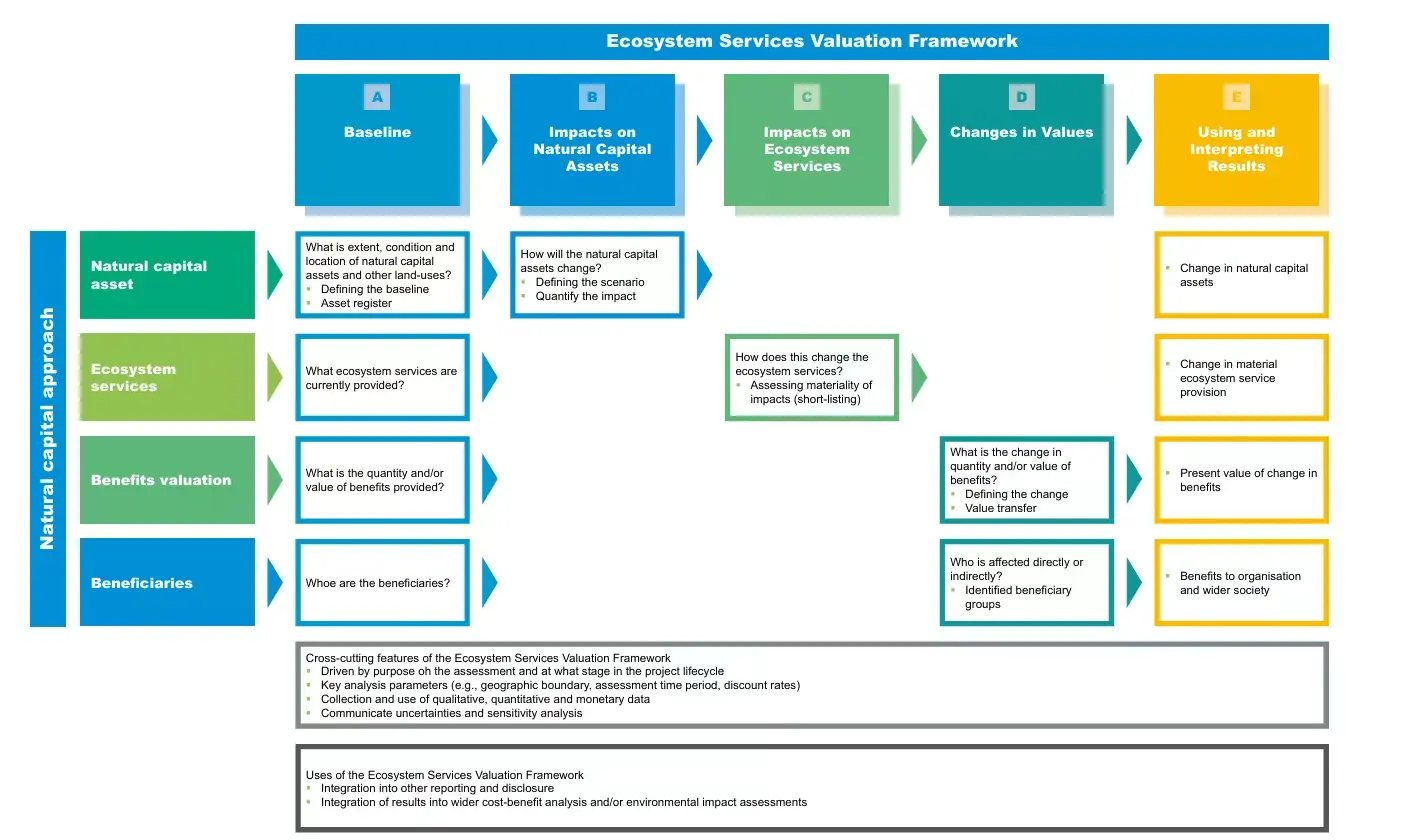
The Five-Step ECOV4R Process
The ECOV4R framework provides a stepwise methodology to assess and value the ecosystem services associated with railway infrastructure. It is scalable, flexible, and modular, supporting both ex-ante (planning/design) and ex-post (retrospective/operational) applications.
Step A – Baseline: Establish Natural Capital Assets and Services Define the current state of natural capital assets and the ecosystem services they provide. Compile an asset register, map spatial extent, and capture condition and ownership. This establishes a counterfactual scenario to measure the impacts of interventions.
Step B – Impacts on Natural Capital Assets: Define the Intervention Scenario Assess how the proposed project or operational change affects natural capital assets. Document changes in extent, condition, or spatial configuration, including direct and indirect effects over time.
Step C – Impacts on Ecosystem Services: Identify Material Changes Evaluate changes in ecosystem services caused by altered assets. Conduct a materiality assessment to select services significant enough for reporting or valuation. Retain non-quantifiable but material services for qualitative reporting.
Step D – Changes in Value: Quantify and Monetise Impacts Measure material changes using quantitative or monetary methods, combining primary data and secondary sources. Apply discounting to calculate present values and aggregate impacts, ensuring consistency and completeness.
Step E – Using and Interpreting Results: Report, Mitigate, Monitor Communicate results for decision-making, integrating impacts into project planning, risk management, and sustainability reporting. Link findings to mitigation opportunities, biodiversity enhancement, or ESG tracking. Establish monitoring indicators for adaptive management over time.
The Pilot Case Studies
Pilot Case Study 1 – Cotswold Line (UK) This pilot applies the ECOV4R framework prospectively to a section of the Cotswold Line in the UK, developed in collaboration with Network Rail. The assessment focuses on the River Evenlode catchment in Oxfordshire and Worcestershire, an area covering approximately 43,000 hectares and exposed to flooding and embankment washouts. Building on a prior feasibility study, it examines a portfolio of natural flood management measures and assesses their effects on ecosystem services, including flood regulation, biodiversity, carbon sequestration, and food production across the wider catchment.
Rail Sustainability - ECOV4R UK Pilot, Marie-Claire Jalaguier & Neil Strong | 6/03/2026
Pilot Case Study 2 – Palencia–León High-Speed Upgrade (Spain) This pilot applies the ECOV4R framework retrospectively to a 16 km section of the Palencia–León high-speed line in northern Spain, managed by ADIF and operational since 2016. Focusing on restored embankments and fill areas within the Duero Valley, the assessment examines wetlands, woodland, and grassland created as part of construction mitigation. Using EIA data and post-construction monitoring, the study evaluates how these measures affected ecosystem services, including carbon sequestration, biodiversity, and cultural services.
Rail Sustainability - ECOV4R Spain Pilot – Marie-Claire Jalaguier & David López Fandos | 6/03/2026
Project Members and Technical Partners
UIC Members
Technical Partners


Conferences Events, Publications and Press
2026
- ECOV4R Project at the 2026 Australasian Conference for Ecology and Transportation (ANET), Brisbane, Australia
- Railway Infrastructure and Ecosystem Services Webinar | ECOV4R Final Project Event to be held on March 6, 2026
2025
- ECOV4R Methodology and preliminary pilot site assessments presented at the 2025 UIC Sustainability Action Week, Paris, France
- ECOV4R Methodology and preliminary pilot site assessments presented at “Integrating biodiversity into transport infrastructure: best practices and innovations” event organised by Futura-Mobility, Online
- “Railways for Nature: A Global Shift Toward Nature-Positive Infrastructure” article published in the June 2025 issue of RailwayPro
- “A global shift towards nature-positive infrastructure” article published in the July 2025 issue of International Railway Journal
- ECOV4R Methodology and preliminary pilot site assessments presented at the World Congress on Rail Research 2025
2024
- Conference paper “Preserving Biodiversity in Railways: Global Strategies for Sustainable Habitat Management” presented at the 2024 Transport Research Arena (TRA), Dublin, Ireland
- Assessing Ecosystem Services in Railway Infrastructure: ECOV4R Methodology presented at the Infrastructure and Ecology Network Europe (IENE) Conference 2024, Online
- An article in Corriere della Sera discusses sustainability initiatives by Ferrovie dello Stato (FS Group) and mentions the participation in the ECOV4R project
2023
- Interactive session on ecosystem services and railways at the 2023 Australasian Network for Ecology & Transportation (ANET), Christchurch, New Zealand and online
- Railway Infrastructure and Ecosystem Services Webinar | ECOV4R Final Project Event to be held on March 6, 2026
- ECOV4R poster
v_ecov4r_poster_ready_for_format_by_coralie.pdf
PDF · 616 KB
ecov4r_pilot_assessment_network_rail_published.pdfecov4r_framework_published.pdfecov4r_pilot_assessment_adif_published.pdfv_ecov4r_poster_ready_for_format_by_coralie.pdf
Documents
v_ecov4r_poster_ready_for_format_by_coralie.pdf
PDF · 616 KB
ecov4r_pilot_assessment_network_rail_published.pdf
PDF · 3.7 MB
ecov4r_framework_published.pdf
PDF · 2.7 MB
ecov4r_pilot_assessment_adif_published.pdf
PDF · 5.3 MB