
Alternative Treatments to creosote for wooden sleepers
At-Wood
Project description
Project objectives
- Update on the development and research progress on the methods/solutions to replace creosote treated wooden sleepers,
- Aim to help users, mainly IMs to make free and conscious choices on alternatives according to their company strategy,
- Encourage the industry to invest more in R&D to find new alternatives; and also, in production capabilities to fulfil the current demand for wooden sleepers, in a sustainable way,
- Favour the creation of a market frame avoiding monopoles, challenging firms to search for alternatives technically, environmentally, and sanitarily more performant, and cheaper.
Consortium · 9 members









UIC contact
Deliverables
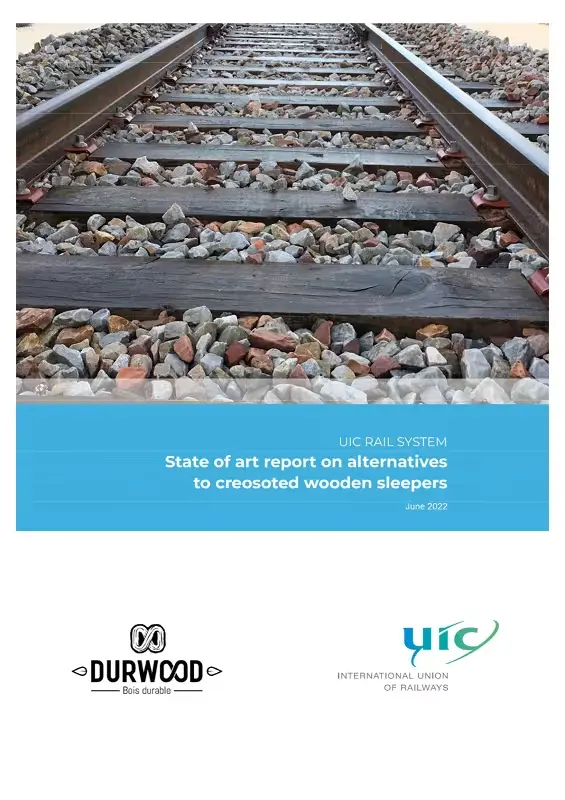
The sleeper is an essential part of the track. The sleepers tie the rails together, they prevent any dangerous relative lateral movement and provide support for the rails (Le Pen, 2008). The railroad tracks are made up of rail lights whose gauge is maintained constant by the sleepers. The sleeper is therefore a fundamental element that allows the maintenance of the gauge and the inclination. Laid across the track, they also transmit to the ballast the loads of vehicles travelling on the tracks (Martin, Vargas-Gonzalez, & Ekambi, 2016). Their function is to transfer and distribute the transported rail loads to the ballast, transversely secure the rails to maintain the correct gauge-width and to resist the cutting and abrading actions of the bearing plates and the ballast material (Zhao, Chan, & Burrow, 2007). Sleepers also resist the lateral and the longitudinal movement of the rail system.
It is therefore important (and soon urgent) to find an alternative treatment in order to be able to continue using wooden sleepers. The railway sector is also an essential sector to ensure the sustainability of the timber industry because it allows the promotion of secondary qualities.
In addition, finding a product that is cleaner for both the environment and human health is a challenge that is increasingly becoming part of current mentalities. Many rail networks attach importance to these considerations. Some public contracts are no longer awarded solely based on price but take into account environmental criterion (Renette, 2021).
This study was commissioned by the UIC. The main objective is to help Infrastructure Manage (IM) to improve knowledge about alternatives to replace creosoted wooden sleepers, without a negative impact on health and environment. To meet this objective, an updating on the state of art in wooden sleepers, types, alternative treatments, and potential alternative non-wooden materials is made.
Before an overall analysis and conclusion, this report is divided into three main parts:
Update on policy and legislative aspects; Literature and research project review: data collection and assessment; Survey to UIC-Members.